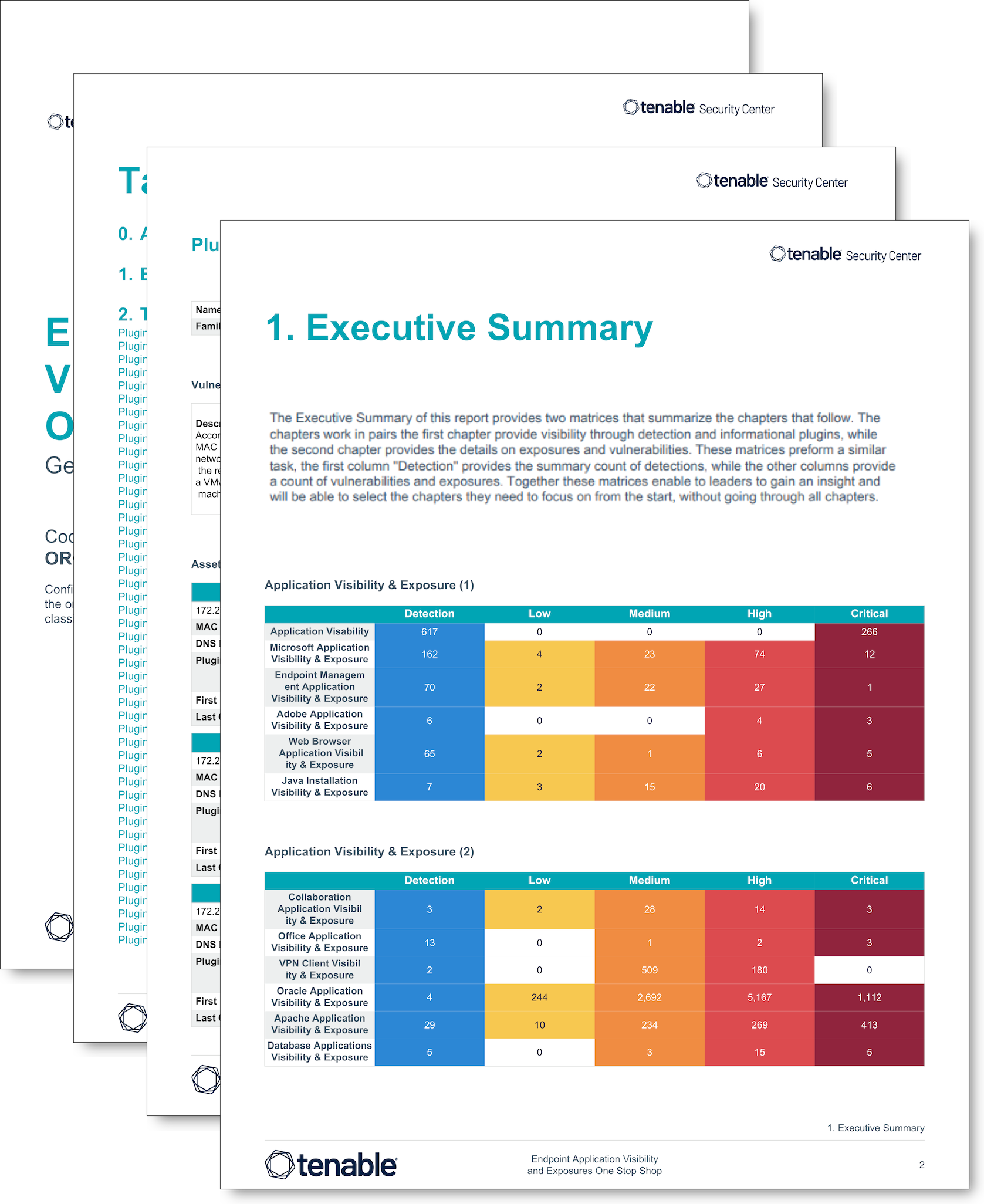
Security Managers and Security Engineers confront fragmented endpoint application visibility where diverse software deployments proliferate across enterprise infrastructure without centralized oversight, creating blind spots that leave the organization vulnerable to exploitation through unpatched applications, unsupported versions, and unauthorized installations. Security Managers need to allocate remediation resources effectively when the scope and distribution of endpoint applications remains unclear, while Security Engineers require accurate deployment inventories to plan patching campaigns that address the broadest exposure surfaces first. Endpoint applications proliferate across enterprise infrastructure without centralized oversight, creating blind spots that leave organizations vulnerable to attack. The Tenable Vulnerability Management report solves this issue by delivering comprehensive endpoint application visibility paired with vulnerability severity prioritization that transforms raw deployment data into actionable remediation intelligence organized by application category, vendor, and exploitation likelihood.
Security Managers leverage this report to establish governance oversight across the complete endpoint application landscape, where visibility chapters reveal deployment patterns for Microsoft applications, web browsers, Java runtimes, and other critical software categories. The application inventory baseline enables informed decisions about software standardization initiatives by quantifying which applications dominate the deployment footprint and where version fragmentation creates unnecessary patching complexity. Understanding deployment distribution patterns supports strategic resource allocation by identifying which application categories require the greatest remediation investment based on installation volume multiplied by vulnerability frequency. This report helps to translate application deployment counts and vulnerability concentrations into business risk metrics that justify standardization programs, lifecycle management investments, and compensating control deployments where immediate remediation proves infeasible.
Security Engineers utilize the exposure chapters to prioritize remediation efforts using Tenable VPR scoring that reflects real-world exploitation likelihood rather than relying exclusively on traditional severity ratings that treat theoretical and actively exploited vulnerabilities identically. The vulnerability-focused chapters covering Microsoft applications, Adobe exposures, and other critical application categories enable targeted patching campaigns where concentrated effort yields measurable risk reduction across the broadest endpoint population. VPR-based prioritization shifts remediation focus toward vulnerabilities with demonstrated exploitation activity, ensuring limited patching windows address the exposures most likely to be weaponized before adversaries exploit the gap between vulnerability disclosure and organizational response. The details within each chapter supports capacity planning by quantifying affected asset counts per vulnerability, enabling accurate estimates of remediation effort required to close specific exposure gaps.
The organization unifies endpoint application visibility with vulnerability exposure intelligence to transition from reactive patching into proactive risk reduction where remediation decisions align with actual business impact rather than arbitrary severity thresholds. Seeing everything across the endpoint application landscape establishes the foundation for predicting which exposures demand immediate attention based on exploitation patterns, deployment concentration, and business criticality of affected systems. Acting with confidence requires the intersection of deployment awareness and threat intelligence that this report delivers through paired visibility and exposure chapters for each application category. Security Managers and Security Engineers collaborate through complementary perspectives where strategic resource allocation decisions informed by deployment scale converge with tactical remediation execution guided by VPR-prioritized vulnerability intelligence to achieve measurable risk reduction across the enterprise endpoint population.
Chapters
Top Installed Applications: Security Managers utilize this chapter to establish a comprehensive baseline of endpoint application deployments across the enterprise infrastructure, enabling informed decisions about software standardization and security resource allocation. Uncontrolled application proliferation creates blind spots where unpatched or unauthorized software introduces vulnerabilities without centralized oversight or governance awareness.
Unsupported Product Summary: Security Managers utilize this chapter to quantify endpoint applications that have reached end-of-life status where vendors no longer provide security updates, creating persistent exposure gaps that cannot be resolved through traditional patching. Unsupported software demands strategic migration planning or implementation of compensating security controls because newly discovered vulnerabilities will never receive vendor-supplied patches regardless of severity or exploitation activity.
Microsoft Application Installation Visibility: Security Engineers leverage this chapter to maintain precise awareness of Microsoft application distribution patterns that directly influence patch management capacity planning and remediation workflow sequencing. Microsoft productivity and enterprise applications represent the largest vendor-specific software category across most enterprise environments, and version fragmentation compounds vulnerability exposure when multiple releases coexist without standardization enforcement.
Top Microsoft Application Related Vulnerabilities: Security Engineers leverage this chapter to prioritize remediation activities for Microsoft application vulnerabilities that affect the broadest portion of the enterprise endpoint population. Microsoft applications represent the dominant software category in most enterprise environments, and vulnerabilities in productivity tools frequently become targets for exploitation campaigns due to the ubiquitous deployment footprint.
Installed Endpoint Management Application Visibility: Security Managers utilize this chapter to verify comprehensive deployment coverage of security monitoring, endpoint protection, and configuration management tooling across the enterprise infrastructure. Gaps in management tool deployment represent operational blind spots where assets operate without centralized oversight, vulnerability scanning, or policy enforcement capabilities.
Top Endpoint Management Application Vulnerabilities: Security Managers utilize this chapter to address vulnerabilities in the security monitoring, endpoint protection, and configuration management platforms that the organization depends upon for maintaining operational oversight across distributed assets. Vulnerabilities in management tooling create paradoxical exposure where the systems designed to protect infrastructure become attack vectors themselves, potentially granting adversaries privileged access to monitoring consoles and policy enforcement mechanisms.
Adobe Application Visibility: Security Engineers leverage this chapter to track Adobe application deployment patterns across the enterprise, identifying where document viewing and creative content tools create potential vulnerability exposure surfaces. Adobe applications frequently serve as attack vectors through malicious document delivery, making deployment awareness critical for anticipating remediation demands when vulnerabilities are disclosed.
Top Adobe Application Exposures: Security Engineers leverage this chapter to prioritize remediation of Adobe application vulnerabilities that frequently serve as initial access vectors through malicious document delivery and exploitation of document rendering engines. Adobe applications process untrusted content from external sources daily, and vulnerabilities in document readers and creative tools enable adversaries to execute code through seemingly legitimate file attachments shared via email and collaboration platforms.
Web Browser Application Visibility: Security Managers utilize this chapter to evaluate browser standardization discipline across the enterprise, where competing browser installations fragment security policy enforcement and complicate vulnerability remediation workflows. Browser diversity beyond approved standards increases the attack surface by multiplying the number of vulnerability streams requiring concurrent monitoring and patching attention.
Top Web Browser Related Vulnerabilities: Security Managers utilize this chapter to prioritize browser vulnerabilities that affect the largest number of endpoints, where unpatched web browsing applications expose users to phishing campaigns, drive-by downloads, and watering hole attacks through routine internet activity. Browser vulnerabilities represent high-priority remediation targets because exploitation requires minimal user interaction and attack delivery scales efficiently through compromised websites and malicious advertisements.
Java Installation Visibility: Security Engineers leverage this chapter to identify Java runtime environments and development frameworks deployed across the infrastructure, where version proliferation creates cascading vulnerability exposure that compounds remediation complexity. Java installations represent a significant security challenge due to frequent vulnerability disclosures, enterprise application dependencies on specific runtime versions, and the persistence of legacy distributions that organizations struggle to retire.
Top Java Exposures Sorted by Tenable VPR: Security Engineers leverage this chapter to prioritize Java vulnerability remediation using Tenable VPR scoring that reflects real-world exploitation likelihood rather than relying solely on traditional CVSS severity ratings for patching decisions. Java runtime environments power critical enterprise applications, and vulnerabilities in these frameworks frequently become exploitation targets due to the broad deployment footprint and the availability of public exploit code for Java-specific attack techniques.
Top Collaboration Application Exposures: Security Managers utilize this chapter to prioritize remediation of collaboration platform vulnerabilities that threaten the confidentiality of sensitive business communications, strategic planning discussions, and intellectual property shared through conferencing and messaging applications. Collaboration tools process sensitive information including financial projections, merger discussions, and personnel matters, making vulnerabilities in these platforms attractive targets for adversaries seeking corporate intelligence through communication interception.
Office Application Visibility: Security Engineers leverage this chapter to track office productivity suite deployments that employees depend upon for daily business operations including document creation, presentations, and data analysis. Office applications represent high-value attack vectors because malicious documents exploiting macro vulnerabilities and embedded exploits remain among the most effective initial access techniques used in targeted campaigns.
Top Office Application Exposures: Security Engineers leverage this chapter to prioritize vulnerabilities in office productivity applications that commonly serve as initial access vectors through malicious document campaigns targeting enterprise users. Office suite vulnerabilities enable macro-based exploitation, embedded object attacks, and document-rendered code execution that adversaries deliver through business email compromise and targeted phishing operations.
VPN Client Visibility: Security Managers utilize this chapter to verify remote access client deployment coverage that protects the security boundary between distributed workforce endpoints and corporate network resources. VPN clients provide direct network connectivity into sensitive internal environments, and gaps in deployment or outdated versions represent pathways that bypass perimeter security controls entirely.
Top VPN Client Exposures: Security Managers utilize this chapter to prioritize vulnerabilities in remote access clients that could compromise the security boundary between the distributed workforce and corporate network resources. VPN client vulnerabilities represent critical exposure because successful exploitation grants adversaries the same network access privileges intended exclusively for authorized remote employees, bypassing perimeter defenses entirely.
Oracle Application Visibility: Security Engineers leverage this chapter to track enterprise software components from Oracle deployed across the infrastructure, where database clients, middleware, and application server installations support mission-critical business processes. Oracle applications frequently underpin financial systems, human resources platforms, and customer relationship management tools, making version awareness essential for maintaining operational continuity during patching cycles.
Top Oracle Application Exposures: Security Engineers leverage this chapter to prioritize vulnerabilities in Oracle enterprise software components that support mission-critical business applications including database platforms, middleware, and application server infrastructure. Oracle application vulnerabilities require careful remediation coordination because patching complex enterprise software involves dependency validation, regression testing, and scheduled maintenance windows that extend remediation timelines beyond standard patching cadences.
Apache Application Visibility: Security Managers utilize this chapter to maintain awareness of open-source infrastructure components from the Apache Software Foundation deployed across the enterprise, where community-supported software requires the organization to assume direct responsibility for security monitoring and update management. Open-source applications lack vendor-managed patch distribution mechanisms, requiring proactive tracking of community security advisories and manual coordination of update deployments.
Top Apache Application Exposures: Security Managers utilize this chapter to address vulnerabilities in Apache open-source infrastructure components where the organization assumes direct responsibility for security monitoring and update management without vendor-managed patch distribution mechanisms. Open-source application vulnerabilities require proactive tracking of community security advisories because patch availability depends on volunteer maintainer responsiveness rather than commercial support obligations with defined service commitments.
Most Prevalent Database Applications Installations: Security Engineers leverage this chapter to identify database application deployments across the infrastructure, where data storage platforms house sensitive business information requiring heightened security attention and coordinated patching strategies. Database applications underpin critical business processes including financial transactions, customer records, and intellectual property storage, making deployment awareness essential for protecting information assets.
Top Database Exposures: Security Engineers leverage this chapter to prioritize database vulnerabilities with urgency given the sensitive information these platforms store including financial records, customer data, and other sensitive information assets. Database vulnerabilities threaten information confidentiality and integrity at the most fundamental level, and successful exploitation can result in mass data exfiltration, regulatory compliance violations, and reputational damage that extends far beyond the immediate technical impact.
Tenable One
Request a demo
The world’s leading AI-powered exposure management platform.
Thank You
Thank you for your interest in Tenable One.
A representative will be in touch soon.
Form ID: 7469
Form Name: one-eval
Form Class: c-form form-panel__global-form c-form--mkto js-mkto-no-css js-form-hanging-label c-form--hide-comments
Form Wrapper ID: one-eval-form-wrapper
Confirmation Class: one-eval-confirmform-modal
Simulate Success